
In recent months, something curious has been happening in SEO: impressions, the number of times your brand appears in search results, are rising, but clicks to your site are falling.
That gap between visibility and engagement is known as the great decoupling, according to Search Engine Journal.
This trend stems largely from Google’s growing use of AI-generated “Overviews,” which summarize answers directly within search results, such as this.
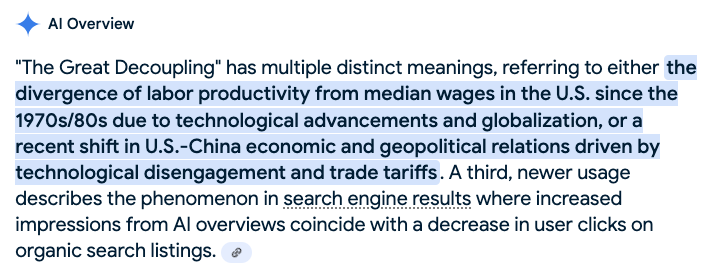
Overviews display relevant content, especially from high-ranking pages, without requiring users to click through. “As a result, your site may still appear prominently and get counted as an impression, but the user often never leaves Google’s page,” claims Ahrefs.
That is otherwise known as “zero-click” content. Examples include:
- Featured snippets
- Google’s AI Overviews
- Knowledge panels
- Local packs and maps
- “People Also Ask” dropdowns
Essentially, searchers get their answers instantly, leaving the your website with the impression but no traffic or clicks.
Why It Matters
For business owners, the great decoupling isn’t just an SEO trend. It’s a shift that directly impacts how potential customers find, trust, and engage with your brand online.
Your business may still appear prominently in search results, but fewer users are clicking through to your site. This makes brand presence in search more about recognition than raw traffic numbers.
Even when people don’t click, repeatedly seeing your business in AI Overviews or top snippets builds credibility. Consistent exposure also positions your brand as reliable and knowledgeable in its field. This helps it to meet Google’s Experience, Expertise, Authoritativeness, and Trustworthiness or E-E-A-T framework.
Visitors who do make it to your site are often more motivated. With casual browsers satisfied by AI summaries, the remaining clicks are more likely to come from users who are ready to engage or convert.
How To Respond
Here are ways you can adapt to the decoupled landscape and still succeed in the SEO game.
1. Shift to Broader Visibility Metrics
Focus less on traffic volume and more on engagement signals, brand recall, and search engine result page (SERP) visibility. That means measuring success not only by traffic, but also by engagement, brand recall, and brand strength, i.e., keyword ranking. Plus, if AI Overviews are featuring your brand, that counts for something—right?
2. Create More Original, Purposeful Content
Unique, thoughtful content can spark interest, even outside of search. “AI Overviews don’t invent answers. They draw from trusted online sources. That means Google still relies on high-quality, well-optimized content to build its responses,” writes Dan Taylor, a Search Engine Journal VIP Contributor.
3. Adapt to AI Overviews
Since Overviews pull from top-ranking content, one way to adapt is to optimize your most informative and authoritative pieces by making them clear, concise, and easily “excerptable.” By this, I mean creating content that answers people’s questions in an outline format, e.g., this blog post.
4. Diversify Traffic Channels
Relying solely on organic search is less reliable today than it may have been in the past. Consider investing in social content, thought leadership, paid placements, and other channels, such as Reddit and YouTube, to regain engagement.
5. Embrace Strategic Storytelling Across Channels
With SEO no longer delivering the same volume, weave your content into narratives on social media, newsletters, and even in sales outreach. Also consider turning product or service pages into resources with FAQs, reviews, comparison tables, or guides and videos. That mindset shift extends the reach of your content beyond search snippets.
6. Track What You Can’t See
Google doesn’t currently show you which visits (or lack of visits) are coming from its new AI summaries. That means you won’t see a neat report that says, “This many people saw your brand in an Overview.”
But you can watch for clues:
- Are your impressions (how often you show up in search) going up while clicks (visits to your site) are going down?
- Are people spending less or more time on your site once they arrive?
- Do certain pages that used to get traffic suddenly flatten out?
By comparing these patterns over time, you can get a good sense of how Google’s AI features are influencing your visibility and engagement, even if the data isn’t spelled out for you.
Search Is Changing
The great SEO decoupling reveals that search is evolving, and your strategy must evolve too. Instead of grieving lost clicks:
- Build content and brand presence that earn attention,
- Track broader signals of awareness,
- Lean into storytelling, and
- Don’t put all your eggs in the SEO basket.
Visibility still matters; how you act on it now is what counts.
Need help deciphering your metrics?
Reach out. We’d be happy to help you decode the riddle.