

The 5 Steps You Need for the AI Search Era
If you are still choosing topics based solely on search volume and “blue link” rankings, you aren’t just behind the curve—you’re invisible. In 2026, keyword research has evolved from a game of matching words to a mission of mapping human intent for both users and AI agents.
Here is the modern blueprint for mastering keyword research in an era where the “Search” button is being replaced by the “Answer” engine.
Quick Tip: Want to see if you’re currently appearing in AI Overviews?
Run a free domain report using Semrush.
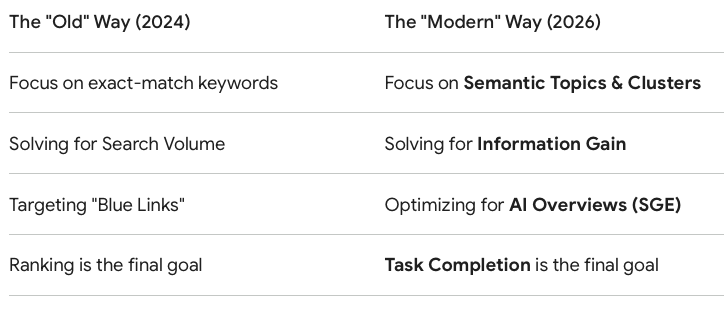
The Great Shift: 2024 vs. 2026
To compete today, you must understand how the rules have changed. It’s no longer about being the most frequent result; it’s about being the most useful one.
“The reality is simple. You’re either the answer AI provides, or you’re invisible. Discovery is happening everywhere: in AI answers, on social, in community forums, and more.” — Andrew Warden, CMO at Semrush.
Adapt or Fade: 4 Essential Pivots for the AI Search Era
1. The “Information Gain” Advantage
AI search models are trained on the existing web. If your content just summarizes what’s already out there, AI agents will do the same for you, leaving users no reason to click. To win, you need information gain, by:
- Mining Your First-Party Data: Stop looking at tools alone. Use real questions from your sales calls, customer support tickets, and internal site search. This “human-verified” data is your moat against AI fluff.
- Injecting Proprietary Insights: Use keywords as a skeleton, but flesh them out with unique case studies, data points, or “hot takes” that an AI cannot hallucinate.
2. Navigating the “Zero-Click” Landscape
With AI Overviews providing instant answers, many high-volume keywords have low click potential. Here’s how to remedy that.
- The Strategy: Don’t waste budget on “Definition” keywords (e.g., “What is SEO?”).
- The Opportunity: Target Commercial and Transactional intent. Users searching for “Product X vs. Product Y” or “Best solutions for [Specific Problem]” still need to click through to see your unique interface, pricing, and community proof.
3. Mastering Semantic Intent Mapping
Keywords are now categorized by where they sit in the buyer’s journey. Use this framework to ensure you aren’t just attracting “tourists,” but actual buyers:
- Informational (Awareness): “How to automate project tracking.” (Goal: Become the trusted teacher).
- Commercial (Consideration): “Top 10 project management tools for 2026.” (Goal: Get on the shortlist).
- Transactional (Decision): “Project management software pricing.” (Goal: Remove friction to buy).
4. Key Metrics for the AI Era
Beyond the classic “Search Volume,” prioritize these three metrics to gauge true success:
- Keyword Difficulty (KD%): Can you compete with the giants for this term?
- Intent Match: Does the content you’re planning answer the user’s underlying “pain”?
- Topic Authority: Does your site have enough related content for Google/AI to trust you as an expert on this subject?
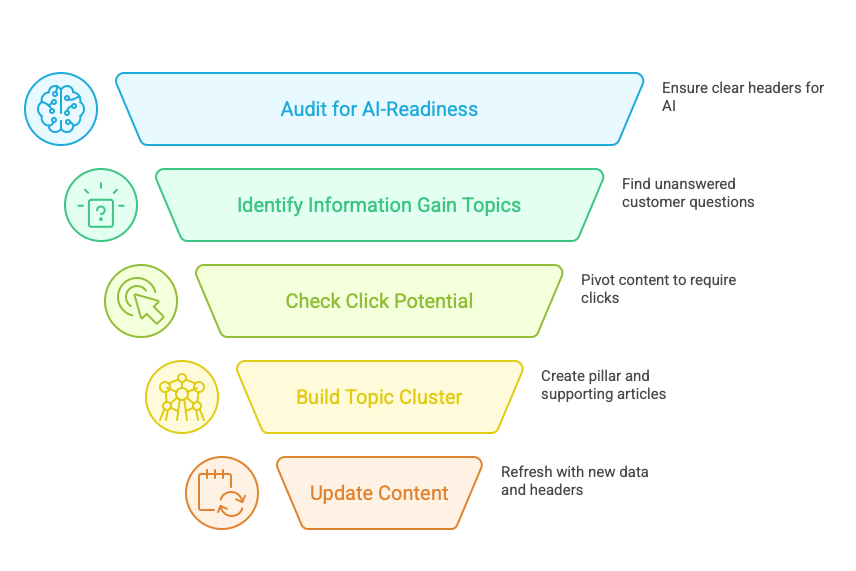
Future-Proof Your Content: Your 5-Step Checklist
Ready to move your strategy into 2026? Follow these steps this week:
- Audit for “AI-Readiness”: Review your top 10 pages. Do they have clear, conversational H2 headers that an AI assistant can easily parse and cite?
- Identify 5 “Information Gain” Topics: Interview your sales team today. Find 5 customer questions that aren’t answered well on Google…yet.
- Check “Click Potential”: Search for your target keywords. If an AI box answers the query completely, pivot that content to a “How-To” or “Comparison” angle that requires a click.
- Build a Topic Cluster: Don’t just write one post. Write one pillar piece and four supporting “long-tail” articles to prove your topical authority to the algorithm.
- Update, Don’t Just Create: Take a post from 2024 and refresh it with 2026 data, new intent-based headers, and a “Direct Answer” paragraph at the top for AI snippet eligibility.
The Bottom Line
In the AI search era, the winner isn’t the one with the most keywords; it’s the one who provides the most “Information Gain.” Stop writing for the bots, and start writing for the humans the bots are trying to help.
Is your content ready for the AI shift?
Don’t wait for your rankings to drop before you adapt. Use our AI-Readiness Checklist to audit your top-performing pages and ensure you’re providing the “Information Gain” that Google and AI agents demand.
Grab the Free Checklist Now!
Disclaimer: Becky Livingston is a Semrush Ambassador.